 In the will of the Lord, we will hold our 47th annual Family Conference as follows:
Dates:
Wednesday, July 1 – Sunday, July 5, 2026
Venue:
Indiana Wesleyan University, Marion, IN*
Theme:
Faith that Works
Faith without works is dead. – James 2:26
Speakers:
 Br. Jerry George Matthew, Bengaluru, Karnataka, India – Jerry is an itinerant Bible teacher, mentor, and educational consultant. He is in fellowship at Bethesda Assembly, Bangalore, where he serves as an elder, and was commended to the Lord’s work from there in January 2024. He completed his doctoral studies in Human Anatomy and taught medical students for about 12 years, and later served as Principal of Clarence High School, Bangalore, until 2023. He is involved in Bible teaching, mentoring, counseling, and educational consultancy. Jerry and his wife, Blessy, have one daughter, Abigail.
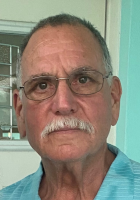 Br. Enrique “Henry” Sardiña, Henry was born in Havana, Cuba, in 1953 and came to the United States after Fidel Castro’s takeover. He was saved in 1984 in Nassau, Bahamas, and has since been active in the Lord’s work, being commended from assemblies in 1987, 1993, and later in Florida. The Lord has widely used his Spanish-speaking ministry in the US, Latin America, and Spain. He continues in itinerant preaching, evangelism, and pastoral teaching. Henry and his wife, Lisa, have six children and thirteen grandchildren.
 Br. Christopher Mattix, North Augusta, SC -Christopher, born in Bolivia to American missionary parents, is a full-time commended worker with the Christian Workers Fellowship (CFW). He is an author, filmmaker, international conference speaker, and Bible teacher.
Christopher earned a Bachelor’s Degree in Biblical Exposition and Theology from Emmaus University (summa cum laude). He served as a full-time missionary with CMML (2013–2022) and now continues his ministry as a commended worker. He has ministered in churches, conferences, and Bible schools in dozens of countries across North and South America and even in Europe. His preaching and teaching emphasize a Christ-centered Gospel, Church History, Apologetics, and expository preaching through various books of the Bible. He enjoyed equipping students on these topics and others at Bible institutes in Bolivia, Peru, and Argentina, etc. for over a decade.
His ministry has given him extensive experience in radio broadcasting, television interviews, and, most recently, as Producer and Director of the “Unbreakable Church” docu-series.
Christopher and his wife, Genesis, serve together as full-time workers, raising their family to love and proclaim Jesus. His books, including the Spanish international bestseller “Confesiones de un inquisidor”, are available on Amazon. He is fluent in English and Spanish.”
 Br. Raju Kunjummen, Iowa, USA – Raju recently retired as Vice President and Dean of Academic Affairs at Emmaus Bible College. He also served previously at Moody Theological Seminary-Michigan as Associate Professor of Biblical Languages and Old Testament. His academic training includes studies in Biochemistry, Old Testament, and doctoral work in Semitic Languages. He taught in Bible colleges and seminaries for over 27 years. A commended worker among the Brethren, he has served as an elder for many years and continues in ministry among assemblies in the US and overseas.
 Br. Jacob C. M., Houston, TX – Jacob was raised in a Brethren family in Kerala and later moved to the UAE, where he lived for 36 years. During that time, he served for many years as an elder in the Sharjah Brethren Assembly and ministered widely as an itinerant Bible teacher and preacher. He has also held senior executive roles and pursued advanced studies in engineering, management, psychology, and theology. In 2024, he moved to Texas with his wife, Leni, and their three daughters. He now serves as an elder at Stafford Bible Chapel.
 Br. George P. John – Frisco, TX – George was born and raised in Chethackal, Ranny, Kerala, and received Bible training at Bethany Bible Institute and Hindustan Bible Institute. He helped establish assemblies in the Dallas area and has served as an elder at Edmonds Lane Bible Chapel, Lewisville, for many years. He has led and supported numerous short-term mission trips in India, Africa, and South America. He has also served for over 30 years with Gospel Missions of India and continues to assist in the work of the IBF conference. George and his wife, Molly, have two children and four grandchildren.
Other Speakers To Be Announced
Plenary Sessions:
Introduction
The Book of James addresses believers who possess genuine faith, but whose lives lack consistency, obedience, and spiritual fruit. Trials reveal instability; relationships reveal partiality; speech reveals inner disorder; attitudes reveal worldly wisdom; and conflicts reveal pride. Many hear the Word without obeying it and profess faith without works. Through vivid instruction and convicting illustrations, James calls Christians to mature into active, humble, obedient disciples marked by love, wisdom, and visible transformation.
Background
The Epistle of James speaks directly to believers whose faith is genuine yet underdeveloped—Christians who know the truth but struggle to practice it consistently in their speech, attitudes, decisions, and relationships. James exposes the gap between confession and conduct, hearing and doing, belief and behavior, calling the church into a living faith that is visible, active, obedient, and mature.
Written to scattered believers facing pressure and instability, James provides a pastoral roadmap for spiritual growth. His message remains strikingly relevant for today’s Christians who are faithful attenders yet passive practitioners, orthodox in doctrine but inconsistent in obedience. James urges believers to move beyond passive faith into faith that works—faith proven through endurance, obedience, love, wisdom, humility, integrity, and compassionate community.
The IBF Conference theme committee organizes this message into five plenary sessions that track the logical movement of the letter and two evening sessions that deepen the practical and spiritual implications for mature believers.
Plenary 1 — Faith That Stands and Obeys
Text: James 1:1–27
Trials test faith’s genuineness and produce steadfast endurance when believers seek God’s wisdom with single-minded trust. Temptations reveal inward desires and call for discernment. But endurance must lead to obedience: the Word implanted in the heart must be put into practice in life. Hearing without doing leads to spiritual deception, but obedience in action reveals true religion, marked by purity, compassion, and self-control.
Summary: Faith that stands under pressure must become faith that obeys in practice. True maturity is seen when endurance produces obedience and when the Word heard becomes the Word lived.
Plenary 2 — Faith That Loves and Works
Text: James 2:1–26
Genuine faith expresses itself through love without partiality. Believers must not judge by appearance or social standing but fulfill the royal law of love for neighbor. Favoritism contradicts Christ’s character. James then deepens the call by confronting the empty confession: faith without works is dead. Living faith is revealed through action, as seen in Abraham and Rahab, whose obedience validated their belief.
Summary: Faith that loves must become faith that works. True faith is impartial, merciful, and always visible through obedient action.
Plenary 3 — Faith That Speaks
Text: James 3:1–12
The tongue directs life. Though small, it wields great power to bless or curse, build or destroy. James warns that inconsistency in speech reveals inconsistency in the heart. Mature believers guard their words carefully, knowing that unrestrained speech leads to spiritual harm and division.
Summary:
Faith that works must govern speech, for the tongue reveals the condition of the heart.
Plenary 4 — Faith That Thinks Wisely
Text: James 3:13–18
Wisdom from above produces purity, gentleness, peace, mercy, and sincerity. In contrast, earthly wisdom—rooted in jealousy and selfish ambition—produces disorder and every evil practice. Mature believers demonstrate their wisdom through their conduct and attitudes, not merely through words.
Summary:
Faith that works must think wisely, embracing the wisdom from above that produces righteous conduct and peaceful relationships.
Plenary 5 — Faith That Submits Humbly
Text: James 4:1–12
Conflicts and quarrels arise from desires at war within believers. Worldliness, pride, and self-will disrupt fellowship with God. James calls the church to repentance: submit to God, resist the devil, draw near in purity, humble yourselves, and stop speaking evil of one another.
Summary: Faith that works submits humbly before God, overcoming pride and restoring peace through repentance and dependence.
Evening Sessions:
EVENING SESSION 1 — Faith That Works in the Heart
Text: James 4:13–5:11
This session examines the internal attitudes that strengthen or weaken practical faith:
Presumption vs. humility in planning (4:13–17)
Materialism vs. eternal perspective (5:1–6)
Grumbling vs. patient endurance (5:7–9)
Discouragement vs. hope through the examples of the prophets and Job (5:10–11)
James teaches that prideful planning, worldly desires, and impatience undermine a living faith. Mature believers cultivate humility, contentment, patience, and trust in God’s sovereign timing.
Purpose:
To expose the internal battles—pride, impatience, worldliness—that hinder faith, and to call believers into a posture of humble, patient, God-centered living.
Approach:
A reflective examination of the heart, highlighting how faith is practiced in private motives, long-term endurance, and humility before God’s sovereignty.
EVENING SESSION 2 — Faith That Works in Community
Text: James 5:12–20
James closes with the outward expressions of a mature working faith:
Integrity in speech—simple honesty without embellishment (5:12)
Prayer in every circumstance—suffering, joy, sickness, and sin (5:13–18)
Confession and healing within the body
Restoring the wandering brother with compassion (5:19–20)
This deep dive section reveals that faith is not private—it is deeply relational. Prayer is not optional; it is the lifeblood of a functioning spiritual community. Integrity, intercession, confession, and restoration are marks of a church where faith truly works.
Purpose:
To equip believers for ministry to one another: praying, confessing, forgiving, restoring, and shepherding the spiritually weak or wandering.
Approach:
A pastoral exploration of community life, showing how mature faith expresses itself through integrity, intercession, and active care for others.
Workshops:
The workshops are offered on multiple days, and the topic is repeated.
Living Out Faith Practically
Explores how genuine faith expresses itself through obedience, endurance, and righteous conduct, reinforcing the central James theme of faith evidenced by works.
Building Spiritual Habits Before 30
Practical spiritual disciplines (prayer rhythms, Scripture intake, repentance practices, accountability structures) that cultivate lasting transformation beyond emotional conference moments. Bible discipline in college, Prayer life without parental structure & Accountability in early adulthood
Preventing Conflict & Building Unity in the Assembly
Practical frameworks for handling disagreements, protecting unity, cultivating humility, and building trust among elders, families, and younger believers.
Raising Christ-Centered Children in a Secular Culture
Equipping parents to disciple their children intentionally in the home—addressing college transitions, digital culture, identity confusion, cultural pressures, and intergenerational faith retention. Practical tools for building spiritual habits, open communication, and gospel-centered parenting.
Interpreting Scripture Rightly
A brief introduction to fundamental concepts about what constitutes a trustworthy interpretation of the Bible (Hermeneutics). How do we make sure that what we say in God’s name, using Scripture, is what He actually said, not our own ideas? Although the topic requires extensive discussion and formal training spans multiple courses, this workshop will focus on fundamental principles and methods. We’ll clarify exactly what it means, how it is to be discovered, and how it is to be applied.
The Scriptures provide many warnings about the careless handling of the word of God (2 Tim 2:15; 1 Tim 1:6-8; 2 Pet 3:15-16; James 3:1,2). We can realize that mere quoting of Scripture may not accord with its intention, since the Bible itself mentions improper use by both the devil and people (Matt 4:6; 19:7; John 6:31), just as many among us employ 1 John 2:27 without understanding it. Biblical interpretation is to be undertaken carefully and in a principled way. The goal of this workshop is to address this fundamental matter and throw some light on ‘how’.
Evangelism in the Digital Age
Christ Jesus commanded his disciples to “Go into all the world and preach the gospel to all creation” (Mark 16:15). The work of preaching the gospel throughout the world is the disciples’ responsibility, and we are to be occupied with this work until the Lord comes. However, this command was given 2,000-plus years ago, and the world has changed considerably.
Today, people, especially young people, interact with one another using social media. In addition, we spend considerable time online consuming news, learning, and other information. This includes websites, blogs, and social media sites such as X, Facebook, Instagram, TikTok, and others. This presents tremendous opportunities and challenges.
How do we make use of these new media to effectively share the Gospel message and our testimony to those familiar and strangers? What are the boundaries of preaching the Gospel online? This interactive workshop will explore how we obey Christ and continue to preach the Gospel in a connected world.
Other Meetings & Opportunities for Fellowship:
In addition to the above Plenary Sessions, Workshops, and Youth Sessions, there are many other meetings and other fellowship opportunities. The following is a list of the many meetings and events:
- Men’s Fellowship Meeting
- Women’s Fellowship Meeting
- Young Children’s VBS
- Youth Classes (KG-3, 4-6, 7-8, and High School)
- Ministry Reports
- Nursery during Plenary Sessions
- Hymn sings
- Excellent Gymnasium (racquetball, volleyball, basketball, exercise room, running/walking track, outdoor tennis courts)
Registration:
Registration is currently open. Please click the link in the menu above (header).
Pricing:
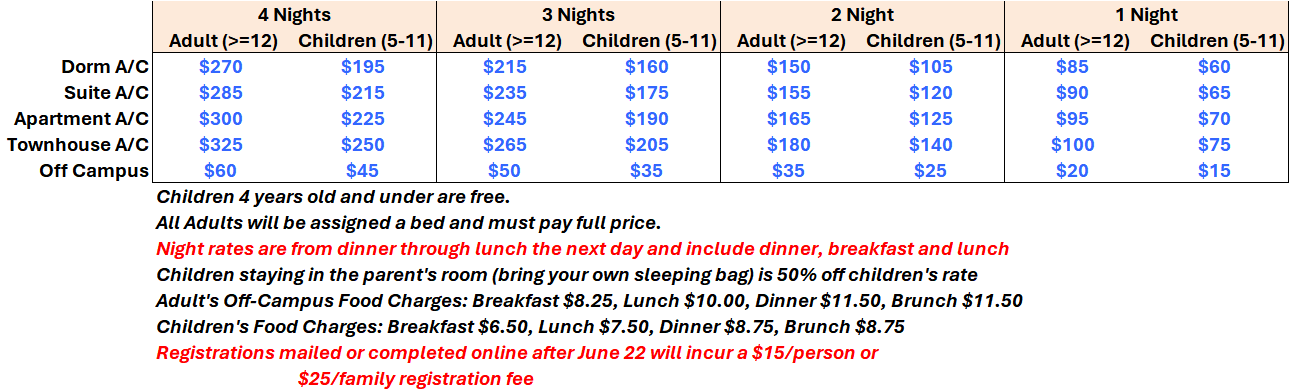
All pricing below is per person.
Housing:
Indiana Wesleyan University has a beautiful campus. We have access to Townhouses, Apartments, Suites, and Dorms. But each of these is limited in number, especially the Townhouses and Apartments. Please review the information below and select the appropriate housing during your registration. Housing is assigned on a first-come, first-served basis, and priority is given to those who register and attend the full conference.
Townhouses are air-conditioned, self-contained units featuring three bedrooms (each with two twin beds), three private bathrooms, a small kitchenette, and a living area. Each bedroom features two twin beds, comfortably accommodating up to six people. This is ideal for a larger family. Each bed includes a basic linen package with sheets, a blanket, a pillow, a towel, and a small soap.
The apartments are air-conditioned and have two bedrooms or three bedrooms (two twin beds in each). The three-bedroom apartment has two bathrooms, and the two-bedroom apartment has one bathroom. Every apartment has a small sitting area and a refrigerator. The apartments can comfortably accommodate four to six people. This is ideal for a larger family. Each bed includes a basic linen package with sheets, a blanket, a pillow, a towel, and a small soap.
Suites are air-conditioned and have two bedrooms (each with two twin beds) and one bathroom, with a connecting bathroom between each bedroom. This is ideal for an average-sized family or for same-sex roommates. Each bed includes a basic linen package with sheets, a blanket, a pillow, a towel, and a small soap.
Dorms are air-conditioned, with four bedrooms (two people per bedroom) and dorm-style bathrooms (typically four bedrooms share a dorm-style bathroom). They are reserved as all-male or all-female housing and are typically not suitable for families. Each bed includes a basic linen package with sheets, a blanket, a pillow, a towel, and a small soap.
When registering, please indicate if you require first-floor accommodation due to a physical disability. We will try to assign you a room on the first floor or in a building with an elevator. We should have plenty of rooms available, but housing is assigned on a first-come, first-served basis. Townhouses typically run out first, followed by Apartments. Please register early to ensure you get your preferred option.
Transportation:
Airport
Please fill out the following form to request a seat on the bus: https://bit.ly/IBF_Airport_2026
The IWU Campus is close to Indianapolis (Indy) International Airport (about 1 hour & 40 minutes away) and Fort Wayne International Airport (about 1 hour away). If anyone plans to fly into Indy, please call Br. Jaby Jacob at (516) 507-2222 or email jaby_jacob@yahoo.com.
If you are flying into the Indianapolis International Airport on Wednesday and require a ride, please plan to board the IWU bus before 2 PM EDT. The bus will depart from the airport at 2:30 PM and arrive at IWU by approximately 4:15 PM. Only one pickup is planned.
On Sunday, the bus will depart from the Townhouses at Noon and arrive at the airport roughly at 1:40 PM. Please plan your departure accordingly. Only one drop-off is planned.
The cost is $25 per person, each way, for using the bus. Please pay the bus cost (both to IWU and return to the airport) when checking in.
NY Bus
The brethren in NY are chartering a 55-passenger bus to travel to IBF, Lord willing. Scheduled pickup is as follows (Departure at 4AM):
1st Stop: 507 White Avenue, New Hyde Park, NY 11040
2nd Stop: IBA Bronx, 3241 White Plains Rd, Bronx, NY 10467
The cost of a seat is $300 per person. To reserve your seat, please contact Rolson at 646-248-1367 as soon as possible.
Contact:
Don’t hesitate to contact (call or text) the following people during the day or early evening.
George Mathew (IL) 847-530-7170 (Registration)
Jebby Tommy (MI) 586-945-5615 (Registration)
George Varghese (MO) 443-636-0324
Regimon Kallinkal (PA) 267-252-9830
John George (MA) 617-605-3212
* This is not a function of the Indiana Wesleyan University